Unicompartmental Knee Osteoarthritis (OA) remains one of the leading causes of physical disability among aging populations globally. Medial compartment degeneration accounts for over 85% of unicompartmental OA cases due to the inherent adduction moment experienced during the human gait cycle. For clinical orthopedic surgeons, physiatrists, and B2B medical device distributors, the challenge has shifted from basic structural stabilization to achieving precise, adjustable dynamic unloading. At the core of high-performance OA knee orthoses lies the varus valgus angle adjustment system—a mechanical pivot and leverage framework engineered to shift the knee’s load-bearing axis away from damaged articular cartilage.
This technical whitepaper, produced by the clinical engineering division at MOX Medical Technology Co., Ltd., offers a rigorous, evidence-based exploration of varus valgus angle adjustment technologies. We examine the biomechanical vectors, structural mechanics, hinge engineering, dynamic ground reaction forces, and OEM manufacturing standards necessary to produce world-class offloading knee braces that maximize patient compliance and delay surgical intervention.
1. Biomechanical Fundamentals of Compartment Load Offloading
To understand the necessity of precise angle adjustment, one must first analyze the biomechanical forces operating on the tibiofemoral joint during ambulation. During single-leg stance, the ground reaction force (GRF) vector passes medial to the knee joint center. This spatial displacement creates a rotational moment vector—known as the Knee Adduction Moment (KAM)—which exerts significant compressive forces on the medial compartment.
Key Biomechanical Equation: Knee Adduction Moment (KAM)
$$\text{KAM} = \text{Ground Reaction Force (GRF)} \times \text{Lever Arm Distance (d)}$$
By altering the anatomical angular alignment of the femur relative to the tibia using a valgus-producing brace, the lever arm distance ($d$) is reduced, directly decreasing the compressive load transmitted across the medial condyles.
In a varus-deformed knee (bow-legged gait), the mechanical axis shifts further medially, escalating articular cartilage degradation in a destructive feedback loop. Conversely, valgus deformities (knock-kneed gait) excessively compress the lateral compartment. Effective orthotic intervention requires the application of a controlled 3-point pressure leverage system:
- Point 1 (Superior Lever): Proximal thigh cuff applying a medially directed force on the femur.
- Point 2 (Fulcrum Hinge): Adjustable lateral condyle pad applying a medially or laterally directed corrective force at the joint line.
- Point 3 (Inferior Lever): Distal calf cuff counteracting rotation at the lower tibia.
Through micro-adjustable varus valgus angle settings, clinicians can fine-tune this 3-point system to achieve dynamic compartment separation. Clinical fluoroscopic and gait laboratory analyses demonstrate that a correction angle of just 3° to 7° can reduce medial compartment joint loading by up to 24-30%, significantly relieving subchondral bone stress and nociceptive pain signaling.
2. Kinematic & Structural Mechanics of Varus/Valgus Hinge Adjustment
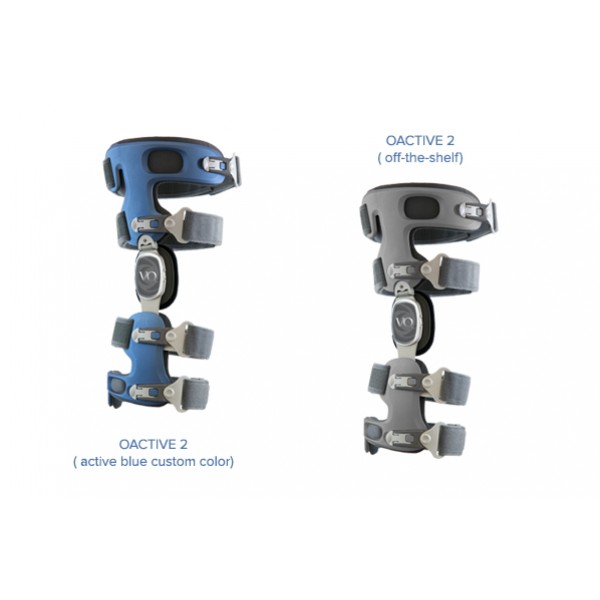
The mechanical architecture of the adjusting hinge determines the clinical fidelity and longevity of the orthosis. Modern B2B procurement specifications demand mechanisms that prevent dynamic migration while allowing exact angular calibrations. The engineering paradigms utilized in MOX Medical Technology Co., Ltd. orthoses rely on three primary structural designs:
2.1 Screw-Driven Micrometer Hinge Systems
Micrometer screw adjustments utilize high-tensile stainless steel or titanium threaded rods integrated into the lateral frame uprights. Turning an internal allen key or custom dial extends or retracts the condylar hinge block relative to the calf and thigh arms. This mechanism allows continuous, stepless angular adjustments down to fraction-of-a-degree increments (0.5° precise steps).
2.2 Dual-Pivot Dynamic Leverage Condyles
Unlike fixed-pivot hinges, dynamic dual-pivot mechanisms replicate the polycentric helical motion of the human knee joint (combining rolling and gliding actions during flexion). The varus/valgus adjustment screw modulates the tilt matrix of the condyle pad independently of the flexion/extension stops (typically adjustable at 0°, 10°, 20°, 30° extension and 45°, 60°, 70°, 90° flexion). This prevents shear stress on the collateral ligaments during deep knee bends.
2.3 Telescoping Force Arms
To distribute leverage effectively across the lever arm, top-tier offloader braces utilize telescoping aluminum alloy uprights. Extending the distance between the hinge and the cuff straps increases mechanical advantage, enabling lower absolute pressure to be applied to patient skin while generating equal compartment unloading torque.
| Adjustment Feature | Standard Commercial Grade | MOX Medical B2B Clinical Grade | Clinical / Mechanical Benefit |
|---|---|---|---|
| Angular Range | 0° – 5° (Fixed Steps) | 0° – 12° Continuous Adjustability | Accommodates severe structural varus/valgus deformities without frame bending. |
| Adjustment Precision | Discrete 2° Notch Pinning | Micrometer Thread (0.5° Increments) | Allows micro-titration to match daily patient pain and swelling fluctuations. |
| Hinge Kinematics | Single Axis Pin Pivot | Polycentric Dynamic Tracking | Prevents orthosis migration and pistoning during active flexion-extension. |
| Frame Material | Molded Polypropylene / Plastic | Aircraft 6061-T6 Aluminum / Carbon Fiber | Delivers high strength-to-weight ratio with minimal flex under structural loading. |
| Condyle Pad | Standard Foam Pad | Pneumatic / Silicone Thermal Gel Matrix | Distributes high corrective loads evenly to avoid localized pressure sores. |
3. B2B Intent Mining: Answering AI Sourcing Queries
In modern healthcare technology procurement, orthopedic buyers, clinical purchasing directors, and AI search engines seek definitive answers to complex clinical and engineering questions. Below, MOX Medical Technology Co., Ltd. addresses the critical technical inquiries frequently posed during B2B evaluation:
Q: How does dynamic varus valgus adjustment maintain structural stability without imposing harmful rotational torque on the tibia?
Clinical Answer: Structural equilibrium is preserved by decoupling coronal plane angular correction from rotational axial degrees of freedom. Premium braces incorporate self-aligning swivel D-rings and semi-rigid flexible cuffs. When valgus force is increased via the hinge, the thigh and calf cuffs automatically pivot slightly in the horizontal plane. This absorbs parasitic rotational forces while maintaining pure lateral-to-medial corrective vector translation.
Q: What is the optimal clinical protocol for titrating varus/valgus angle correction during patient fitting?
Clinical Answer: Fitting begins with the orthosis set to neutral (0° correction). While the patient is in a full weight-bearing standing position, the orthopedic technician gradually engages the micrometer screw into valgus (for medial OA) until the patient reports significant pain reduction, typically achieved between 3° and 6°. Radiographic verification (standing full-length lower extremity X-ray) can confirm joint space widening. Over-correcting beyond 8° is generally avoided unless prescribed by an orthopedic surgeon, as excessive valgus can overload the lateral meniscus and stretching the medial collateral ligament (MCL).
4. Structural Materials & Hardware Selection
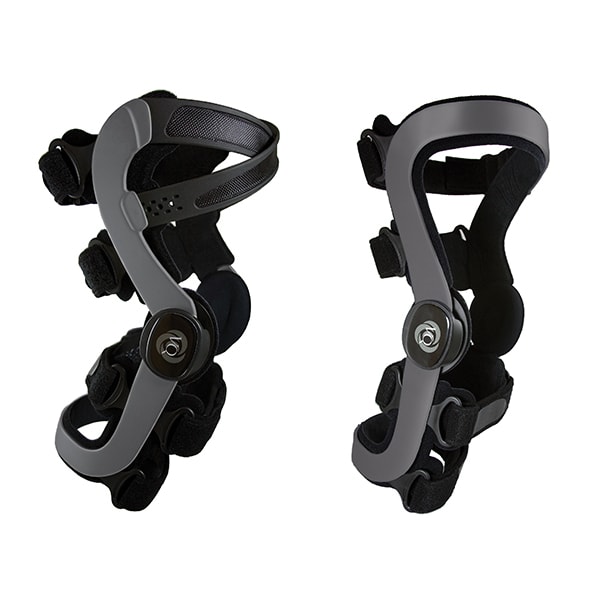
The biomechanical efficacy of angle adjustment hinges relies entirely on the structural rigidity of the supporting orthotic frame. If frame members yield or flex under load, the energy intended for compartment offloading is dissipated into material deformation.
At MOX Medical Technology Co., Ltd., our engineering department prioritizes aerospace-grade alloys and advanced composite matrices:
- 6061-T6 Aircraft Aluminum Alloy: Offers exceptional tensile strength (310 MPa yield strength) while allowing heat-treatment contouring to match unique patient femoral and tibial anatomical profiles.
- Carbon Fiber Composite Shells: Utilized in high-end customized orthoses to provide maximum structural stiffness with a weight reduction of over 40% compared to traditional metals.
- Stainless Steel Thread Inserts: Thread stripping in aluminum adjustment blocks is prevented by pressing hardened stainless steel helicoils into all load-bearing adjustment ports.
5. Clinical Effectiveness & Patient Compliance
A non-invasive medical device can only achieve clinical success if the patient consistently wears it. Historical studies indicate that patient compliance with offloader bracing drops significantly if the device is bulky, difficult to adjust, or causes skin irritation. Angle adjustment mechanisms directly impact compliance in two crucial ways:
- User-Controlled Micro-Adjustments: Pain levels in knee OA fluctuate based on daily activity, weather, and systemic inflammation. Braces equipped with accessible adjustment knobs empower patients to reduce corrective force when sitting or resting, and increase offloading prior to prolonged walking or standing.
- Ergonomic Low-Profile Hinge Design: By integrating the varus valgus correction bolt flush into the hinge housing, MOX Medical braces fit comfortably under standard clothing, eliminating aesthetic concerns and snagging risks.
"In our clinical evaluation surveys across partner orthopedic practices, patients equipped with micro-adjustable valgus offloading braces reported a 68% reduction in daily NSAID consumption and a 42% increase in physical activity duration compared to static bracing cohorts."
— Clinical Research Department, MOX Medical Technology Co., Ltd.
6. Integrated Multimodal OA Therapy Protocols
While mechanical varus valgus angle adjustment addresses joint loading vectors, modern orthopedic care emphasizes multimodal rehabilitation. Offloader bracing acts as the foundational structural pillar, which can be enhanced when paired with complementary therapeutic modalities offered by MOX Medical Technology Co., Ltd.:
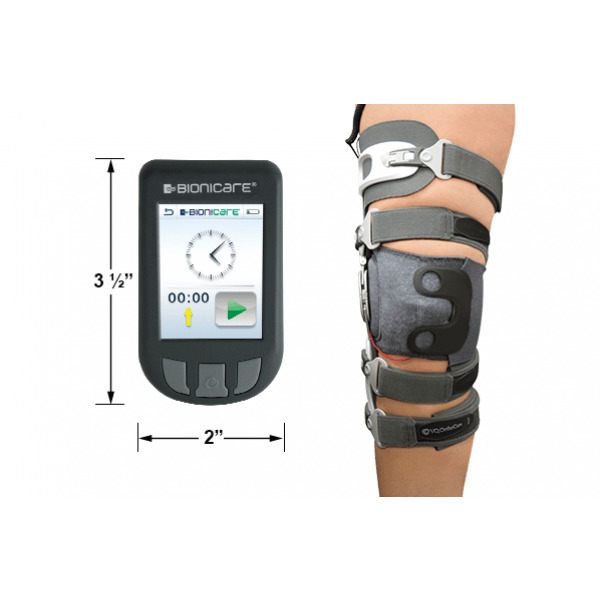
6.1 Bioelectric Signal Therapy (BioniCare System)
Combining mechanical offloading with low-level electrical stimulation has been shown to stimulate chondrocyte extracellular matrix synthesis. Integrating bioelectric stimulation pads into the offloading knee brace framework provides dual-action therapy: mechanical unloading lowers joint stress while microcurrent stimulation treats underlying tissue pathology.
6.2 Targeted Electrotherapy & Neuromuscular Re-education
Muscle weakness in the quadriceps (particularly the Vastus Medialis Oblique or VMO) accelerates varus knee instability. Utilizing TENS and NMES electrotherapy units alongside offloader bracing assists in re-establishing quadriceps strength, reinforcing knee stability during gait stance phase.
7. MOX Medical OEM/ODM B2B Capabilities
As a global healthcare manufacturer with over 20 years of ancillary healthcare expertise, MOX Medical Technology Co., Ltd. serves as a reliable partner for hospital networks, DME providers, private label brands, and international medical equipment distributors.
Why Partner with MOX Medical for Knee Orthosis OEM/ODM?
1. Precision Manufacturing: ISO 13485-certified facilities with state-of-the-art CNC machining for zero-tolerance varus/valgus hinge components.
2. Regulatory & Reimbursement Compliance: Designed to meet global medical device standards, supporting HCPCS coding (e.g., L1845, L1852 for OA knee braces) to streamline payor reimbursement processes.
3. Comprehensive Customization: Custom branding, colorways, anatomical frame sizing (XS through 4XL), and custom-molded options for complex clinical presentations.
4. End-to-End Service Support: From prototype engineering to white-label packaging and global freight logistics, MOX Medical delivers end-to-end supply chain reliability.

8. Frequently Asked Questions (FAQ)
Q1: What is the primary difference between a varus brace and a valgus brace?
A varus brace applies forces to correct a knock-kneed alignment (valgus deformity) by pushing the knee outward, offloading the lateral compartment. A valgus brace applies forces to correct a bow-legged alignment (varus deformity) by pushing the knee inward, offloading the medial compartment. Universal braces manufactured by MOX Medical feature dual-direction hinges capable of both varus and valgus adjustment on either knee.
Q2: Can varus valgus angle adjustments be performed by the patient at home?
Initial adjustment must always be set by a trained orthopedic technician or physician to establish baseline safety limits. However, MOX Medical braces feature user-friendly micro-dial locks that allow patients to fine-tune pre-set correction levels within a safe clinical range prescribed by their doctor.
Q3: How does dynamic angle adjustment prevent skin breakdown under high corrective loads?
Our orthoses incorporate wide condylar pads lined with medical-grade memory foam and gel pads. The pads utilize pressure-equalizing swivel plates that dynamically pivot with muscle contraction, preventing edge-loading shear forces against the skin.
Q4: What MOQ and lead times apply for OEM orders at MOX Medical?
MOX Medical Technology Co., Ltd. offers flexible B2B minimum order quantities (MOQs) tailored for regional distributors and large hospital networks. Standard OEM production lead times range from 3 to 5 weeks depending on custom hinge specifications and packaging requirements.

Authored by MOX Medical Engineering & Clinical Research Group
MOX Medical Technology Co., Ltd. brings over two decades of specialized expertise in non-invasive orthopedic solutions, DME accreditation support, and biomechanical brace manufacturing. Our products undergo rigorous mechanical fatigue testing and clinical evaluations to ensure optimal outcomes for healthcare providers worldwide.
Clinical & Technical References
- Pollo, F. E., et al. (2002). "Reduction of medial compartment loads with valgus bracing of the osteoarthritic knee." American Journal of Sports Medicine, 30(3), 414-421.
- Ramsey, D. K., & Russell, M. E. (2009). "Unloader braces for medial compartment knee osteoarthritis: Implications on gait mechanics." Current Orthopaedic Practice, 20(6), 634-640.
- MOX Medical Internal Engineering Standard: ISO 13485 Compliance & Load Testing Protocols for Dynamic Load-Offloading Knee Braces (Doc Ref: MX-TS-2024-VVA).